What is Social Prescribing?
Sometimes known as a community referral, Social Prescribing enables health professionals to refer people into a range of non-clinical services which address people’s needs in a holistic way, giving more control of their own health. In a prison setting, healthcare departments have a range of signposting options for those needing a little more help to maintain their independence, build resilience, healthy lifestyles and enhance their wellbeing.
How can peer supporters help?
Partner organisations and well-trained peer supporters can play a pivotal role in supporting link workers, leading activities, and interventions to support those struggling.
Our prison Buddies and Threads Maps Champions offer regime adaptations and support services on the wings and landings. The Buddies are trained to National Care Certificate Standards, adapted for use in prisons, and enhance the HMPPS support offer by providing interventions and support in this social prescribing space. We have 15 years of experience delivering these services and can support your prison with resources and services to support your social prescribing requirements. Please look at the wide range of case studies below to see how this might look.
Please note, names and locations have been changed to protect identities.
Download our Social Prescribing brochure
Case study: How the Recoop walking programme improved an individual’s physical wellbeing
The Issue
 Ben had become progressively more inactive due to being in lockdown in his cell for long periods of time. He needed to be motivated to become more active during exercise opportunities as well as in cell.
The solution
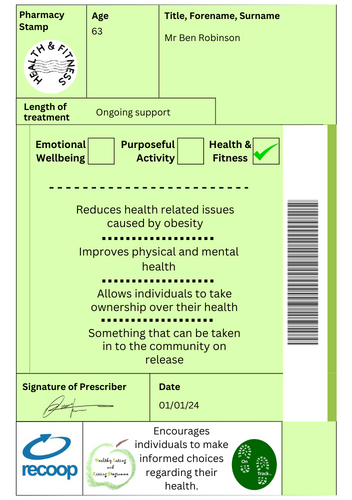
Ben joined a trial of the Recoop ‘On Track’ virtual walking programme hoping it would motivate him to exercise and lose weight.
He was kept ‘On Track’ by the Peer Supporter who would check in with him regularly. He enjoyed the challenge of reaching each destination and it encouraged him to keep going with the programme. Ben has sustained his interest and is still using the booklet and stepometer.
Ben stated that “you have to take it day by day to achieve your goal and notice the progression. If feeling de-motivated, the booklet provided some really good benefits”.
The Impact
- He lost weight.
- Provided him with a sense of purpose.
- Improved his mental health.
- Gave him a goal to work towards.
- Improved his emotional wellbeing.
- Motivated him to exercise.
Case study: How the Recoop Mindfulness booklet and journal helped an individual deal with stressful situations
The Issue

Being in prison can be an incredibly stressful experience and Robert struggled to find coping strategies. With the added pressure of being away from family and friends, alongside the noise and sometimes violent outbursts on his Wing, it was very difficult for him to clear his head and ‘think straight’.
The solution
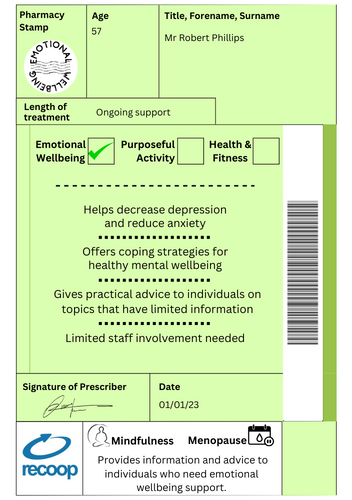
Robert attended a Mindfulness group session and as part of the session he received a Mindfulness booklet and journal, produced by Recoop, to help individuals process stressful situations with meditation, relaxation exercises, safe place imagery and more.
The booklet and journal helped Robert with the stressful situations he found himself in during his time in prison. He stated that “This training pack would definitely help most people I know in this prison. Not just while they are in custody, but also when they are close to release and on release as each stage brings different stresses. Stress is different depending where you are on the sentence. Your stress that you have changes depending if you are at the start, middle or end of your time in custody. For example, if you accept what you have done or are awaiting appeals etc.”
The Impact
- Helped him deal with stress better.
- Promoted a calmer approach to situations.
- Provided a distraction from prison life.
- Improved his mental health.
- Group sessions helped him feel less isolated.
- Reduced his anxiety.
Case study: How the Recoop portable activity toolkit helped an individual feel less isolated
The Issue
 Due to limited staff time and availability, Matthew was provided with little or no purposeful activity. Due to this Matthew spent most of his time in his cell feeling isolated, inactive and unsupported in his basic needs. This in turn impacted his mental health.
The solution
An orderly at a Recoop activity hub ran a ‘Wing It’ session and encouraged Matthew to attend. The ‘Wing It’ activity kit contains group activities, exercises, quizzes and board games to encourage social interaction and needs limited staff involvement. This meant that, although staff were limited in time, they were still able to provide a good level of purposeful activity as an orderly was able to run the session.
Matthew enjoyed the activities and started to attend more sessions at the activity hub, which resulted in him feeling less isolated. He also started to feel more confident within a group environment therefore improving his emotional wellbeing and mental health.

The Impact
- He felt less isolated.
- Provided purposeful activity.
- Provided a distraction from life in prison.
- Built up his confidence.
- Improved emotional wellbeing.
- Encouraged group work and co-operation.