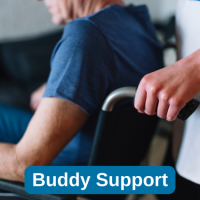
Our managed Buddy Programme is currently in place at six prisons; three in the North West and three in the South West although the Recoop programme is operated in many more by prison and local authority staff themselves. At all of these locations, we have seen a very real impact from both those who train to be a Buddy as well as those receiving support.
Buddies undertake a comprehensive 14-Module training programme (National Care Standards adapted for use in prison) over a number of weeks and once they have completed this training they are then ready to support clients. The care they provide ranges from physical help such as cleaning cells and meal collection to helping support their client’s mental health. Extra modules are also included that cover training on end of life care and bereavement.
In order to get a picture of the effect the Buddy Programme has, we asked 14 clients at HMP Wymott a number of questions to assess the impact having a Buddy had on their physical and mental health.
Independence:
“[My buddy] is helpful, sociable, checks that I’m ok and if I need anything.”
The overall aim of the Buddy Programme is to enable clients to regain their independent and therefore allow them to grow in confidence during their time in prison, although in some cases this may not be possible, such as when they are suffering from dementia or a long-term illness. However, in most cases we would expect the client to eventually be able to undertake activities without support.
Before buddy support, 85% of those surveyed said they felt independent only some of the time, rarely or not at all. However, with buddy support we saw that 79% now feel independent often or all the time.

Support & advocacy:
“If the Buddy wasn’t present I wouldn’t be able to talk with anybody about how I am feeling day to day. But since he’s there, I feel much more supported and I would be lost without him.”
It is estimated that 85% of those over 60 in prison, have some form of major illness and therefore will have an increased need for medical appointments and interventions. Some members of the older cohort may find it difficult to arrange an appointment; this may be because of eye sight issues, uncertainty of information they need to fill in, as well as not having the confidence to raise the issue and get an appointment in the first instance.
We have found that many clients may be more likely to raise issues in regards to their health with their buddy than a member of prison staff. It may also be that the buddy will notice medical issues due to their time spent together and knowing what the clients physical and mental capabilities are.
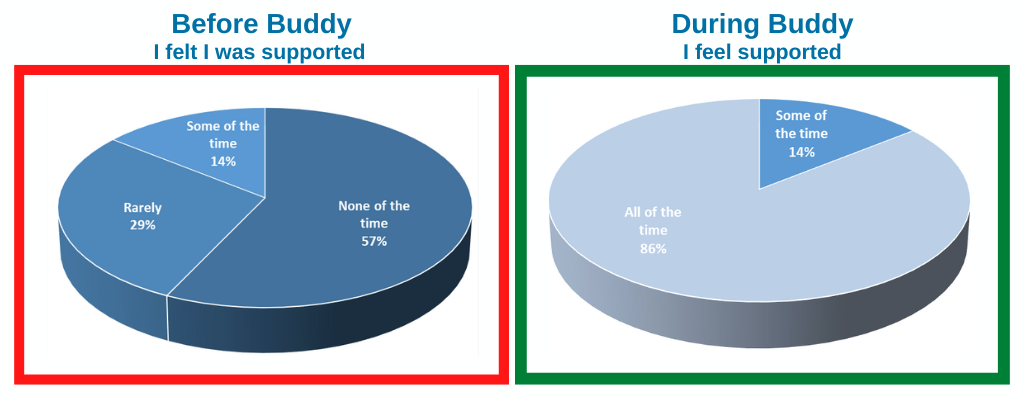
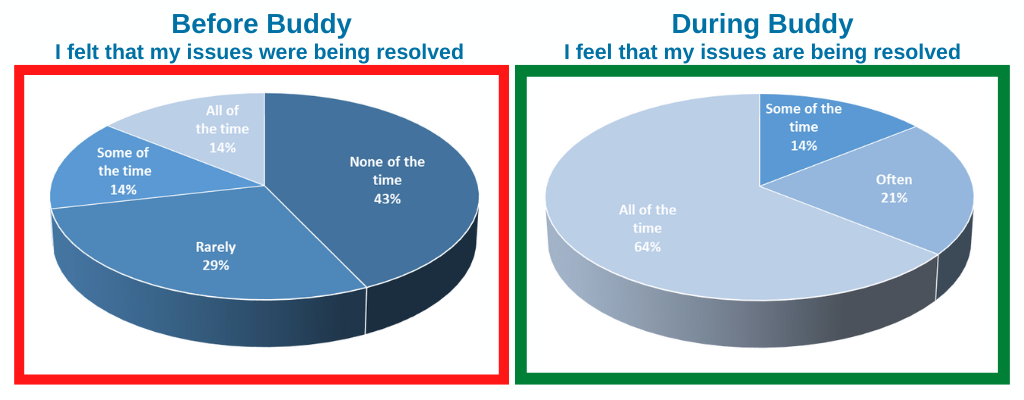
Before buddy support 100% of individuals felt supported only some of the time, rarely or not at all. With buddy support this figure dramatically changes to 86% now feel supported all of the time. Those surveyed also saw a dramatic rise in issues being resolved with 85% of clients feeling that their issues were being resolved often or all the time. Before buddy support 86% of those surveyed felt their issues were being resolved only some of the time, rarely or not at all.
Quality of prison life:
“I’d like to take this opportunity to praise my Buddy, he has in my opinion gone beyond the call of duty just to make sure I am settled, I feel comfortable and I am a lot happier in jail now.”
One aim of the Buddy Programme is to make sure clients gain confidence and independence allowing them to have a better quality of prison life. We have seen from those surveyed that 93% of respondents stated that, prior to having a buddy, they had a good quality of prison life only some of the time, rarely or not at all. However, while receiving Buddy Support 78% of those surveyed stated that they had a good quality of prison life often or all of the time. This shows that the Buddy Programme is key to helping those individuals who are most vulnerable in prison, providing them with the tools to give them a good quality of life in prison.
Purposeful activity is also important in helping keep individuals mentally and physically active, which in turn helps, not only with giving a good quality of prison life, but may also support their rehabilitation. HMPPS states that “Prisoners are able and expected to engage in activity that is likely to benefit them“. Of those surveyed, 85% got involved in activities some of the time, rarely or not at all; this may result in individuals becoming more isolated and may therefore badly impact their mental and physical health. During buddy care, we saw a very positive increase in the figures; 86% got involved in activities often or all the of the time. 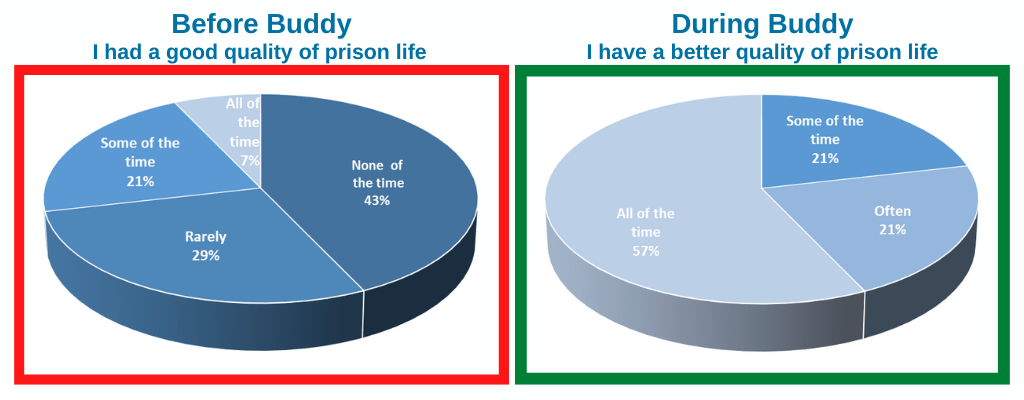

Conclusion:
As we can see from these statistics, the impact of having a buddy is incredibly positive. Many of the clients are becoming more independent, issues are being resolved and therefore they have a better quality of prison life. These results prove that the Buddy Programme is working, and with the Older Prisoner Strategy being released this year, we anticipate that it will feature as a recommendation to support the older cohort.
The Buddy Programme is not only positive for the clients; those who become buddies also find the experience incredibly positive. It can give them purpose and they can actually see the progression of the client over the time they are looking after them.
“I’ve done many jobs in the prison, but being a Buddy is definitely the most rewarding. I can see that I’m making a real difference to a fellow prisoner. Poor bugger, I wouldn’t want to be in his shoes in here. It’s a win-win situation. He gets the support he needs, I get to show that I’m not all bad and that there is still a good side to me”. (Trained Buddy)
If you would like to find out more about the Buddy Programme, please email info@recoop.org.uk.